Basic freediving pool training
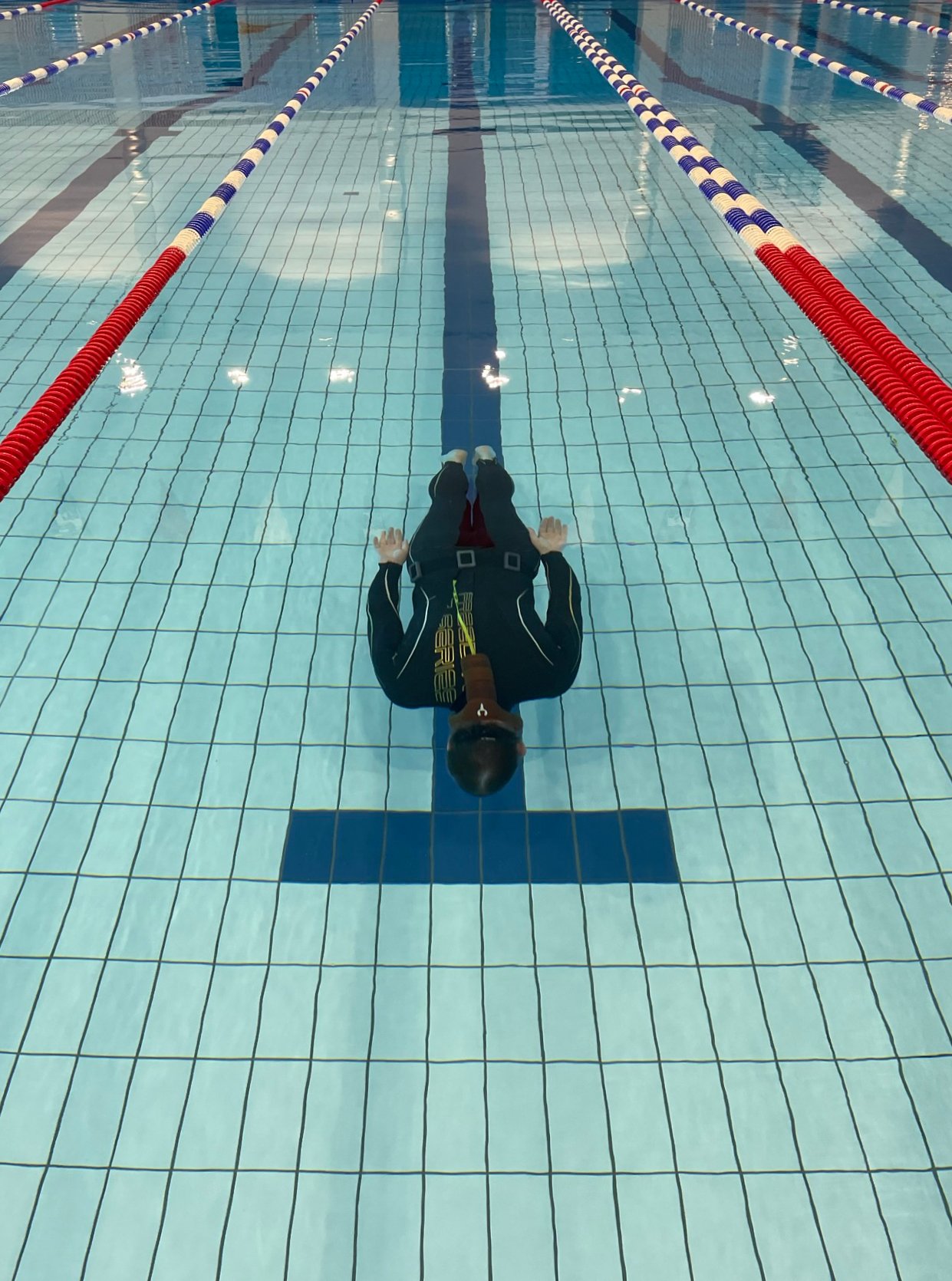
If you are a beginner freediver the most important thing is to get used to the water and to get comfortable holding your breath. It does not have to be long breath holds or long dives, in the beginning it’s better to do a lot of shorter dives instead of a few long ones feeling uncomfortable. It’s more important to be relaxed and develop comfort with holding your breath.
Freediving is not about struggle, it’s about relaxation and good feelings!
Theas examples conclude that you have basic knowledge of fining and swimming techniques for freediving before you try them out. The best way to get this knowledge is to take a freediving course or join a freediving club nearby. These exercises can be exhausting and you could push yourself to a point that you will have a blackout. Never ever dive alone or hold your breath under water without a trained buddy that knows what to do in situations like these.
Training series (tables)
When you start to get comfortable in the water you can start with small training series (tables). A series is an exercise that you do a specific number of times in a row with a fixed or varying recovery time in between. A series can be composed with any lap length or breath hold time combined with any recovery time you feel comfortable with and with any number of repetitions. In the beginning it’s better to start with shorter lap length or breath hold time and longer recovery times and slowly increase and decrease the values in the series.
Serie with fixed or varying recovery time
A series can be 8 laps of 25 meter DYN or DNF with 60 seconds recovery in between. You can also do it a little more challenging by varying the recovery time and for example start with 60 seconds recovery and reduce the recovery time by 5 seconds for every lap.
Example:
Swim 25 meter, recovery for 60 seconds
Swim 25 meter, recovery for 55 seconds
Swim 25 meter, recovery for 50 seconds
Swim 25 meter, recovery for 45 seconds
Swim 25 meter, recovery for 40 seconds
Swim 25 meter, recovery for 35 seconds
Swim 25 meter, recovery for 30 seconds
Swim 25 meter, finish
This series gets harder and harder with every lap. Not only do you build up CO2 in your body you get less and less time to flush it out from your body. A typical CO2 series. You can of course alter the recovery time and length of the laps after your level of comfort.
Serie with fixed start time
Another series is to start a new lap every 90 seconds. So if it takes you 40 seconds to swim 25 meter you will have 50 seconds recovery time until you start the next lap.
Example:
Swim 25 meter in 40 seconds, recovery for 50 seconds
Swim 25 meter in 40 seconds, recovery for 50 seconds
Swim 25 meter in 35 seconds, recovery for 55 seconds
Swim 25 meter in 35 seconds, recovery for 55 seconds
Swim 25 meter in 45 seconds, recovery for 45 seconds
Swim 25 meter in 45 seconds, recovery for 45 seconds
Swim 25 meter in 40 seconds, recovery for 50 seconds
Swim 25 meter, finish
In this series you can alter the swimming speed and the time of your dive to get the ultimate swimming speed and get the right balance of effort putting into the swimming and the recovery time you need before the next dive. When you think 90 seconds is too easy you can just reduce it by 5 seconds next time you do this series and start every 85 seconds. When you do this series starting every 60 seconds you can go back to 90 seconds recovery but instead you add 5 to 10 meter to the length of the laps and do it all over again.
Serie with varying breath hold time
A series often used with STA (static breath hold) is to increase the time you hold your breath but the recovery time is the same. A O2 series. You don’t build up very much CO2 because of longer recovery times between the breath holds but you will get more relaxed for each dive and you will be able to hold your breath for longer throughout the series.
Example:
Hold your breath for 30 seconds, recovery for 60 seconds
Hold your breath for 45 seconds, recovery for 60 seconds
Hold your breath for 60 seconds, recovery for 60 seconds
Hold your breath for 75 seconds, recovery for 60 seconds
Hold your breath for 90 seconds, finish
Goal of the series
These examples aim to slowly extend the length of your dives and your breath hold time but with comfort and control. To make these series work best for you it’s recommended to alter the length, times and repetitions to get the ultimate training for your freediving journey.
Happy freediving and remember, dive safe with a buddy.